Friday, April 10, 2020

Prepping for the next steps--whatever they are

I've been getting by, day by day. My "quarantine" has now lasted for 138 days, with no end in sight. My blood counts have dropped, then gone up a bit, then down some more, but I have still managed to avoid any transfusions since January second. Always looking for silver linings!

I feel for my family and friends, stuck home (or at work) and trying to navigate everything differently with the appearance of COVID-19. For me, in many ways it's made my neutropenic quarantine easier. Greg, Ash & I aren't leaving the house except for doctor appointments (and socially-isolated exercise), so that reduces my fears of catching almost everything.  My doctor appointments are still stressful. Yesterday I spent an hour in a tiny room having an echocardiogram. The tech's face and mine were two feet apart almost that whole time. We both had masks on, but it also involved an awful lot of deep breathing in and out for the images. Ugh...

As far as what my next steps are, I'm not really sure. Since I fell out of remission, I will NOT be going to transplant this month, as was the original plan. I will be starting a clinical trial on April 20th. My appointments have populated my Froedtert app (there are currently THIRTY appointments on it).

The first big chunk of appointments include labs, infusions, appointments, and follow-up labs later that day for days 1-5 of the new chemo regimen. I get a bonus pre-clinical trial bone marrow biopsy this Monday (that will be my sixth). Then from April 20-24, I start my day at 7:40 every morning with labs, followed by chemo. I think I may get to go home for a few hours but then have to return at 3:30 every day for more labs because this new regimen is known to cause liver damage and they need to know right away if that's happening. (Hopefully my life-long minimal alcohol consumption will give me a leg up there!) After those five days, I have "chemo only" on Saturday and Sunday, and then we wait until May 1 to have another bone marrow biopsy, and get the results, which will show whether the new regimen put me back into remission or not.

However, I have to say that I feel comforted that, other than the delay, other plans for my transplant are still moving forward and re-scheduled. I am telling myself that if I were a lost cause, they'd tell me, "oh, we'll wait to re-schedule those." All of those appointments have been scheduled and if, by some miracle I achieve remission again after one round of the new regimen, and all other tests clear me, I'll be admitted to the hospital for ablative chemo on May 13, with a new transplant date of May 19.

After having a few extra tubes of blood drawn on Monday for the clinical trial, I was surprised that my Thursday lab had thirteen tubes. EEK! But the extra tubes were for my pre-transplant work-up! Doesn't this kind of look like a bouquet?


I have already had a meeting (via phone) with the social workers--who are both AWESOME! Seriously, they have been wonderful with providing resources on grants for cancer patients, resources on things like discussions to have with your medical power of attorney, and support in applying for social security disability. All the things that I was searching for when I was first diagnosed in November were provided to me electronically. If only I'd known back then, I wouldn't have had to struggle so much with figuring out all the financials.

Which brings me to my other down side of the week. As of yesterday, I am completely unemployed. Though I knew it was coming, I didn't realize just how hard writing the words, "I resign from my role as Public Health Manager, effective April 9, 2020" would be. I'm still struggling with the loss of my identity as a public health professional, although I've not really WORKED as one since late November. It just hit me harder than I'd hoped. I plan to keep up with as much as I can, which right now is all COVID-19, all the time. :)

And it's a third of the way through #30daysofbiking, and despite social distancing restrictions, I've biked outside every day this month so far. Greg's been a champ, accompanying me on almost every ride. I need to keep my heart and muscles strong for whatever is ahead.


Saturday, April 4, 2020

Tears can be a good thing, too.

This will be a quick post, but I wanted to thank all of you who reached out after my post on Thursday.

I have to say that Thursday was really hard. It felt like a sucker punch to my gut. And if I'm being honest, most of Friday was really hard, too. I read all of your comments on my Facebook post, my blog post, your texts and your messages... But I just didn't have it in me to respond--not even to "like" them on Facebook. I had to just not think about things for awhile. And I had to finally release and cry.

I am not a big crier. But I need to remember that sometimes a good cry is not only okay, but perhaps necessary. I let myself cry Thursday night and much of Friday whenever I felt any emotions. I didn't hold back at all. (Poor Greg...) And slowly the "poor me" and "it's so unfair" tears turned to tears of gratitude. And by Friday night, when I watched Pat McCurdy's Shelter In Place Concert #3 on Facebook Live, I even laughed some.

I am so unbelievably fortunate in so many ways--not just through this awful second cancer diagnosis, but through the whole COVID-19 quarantine thing. I happen to love spending time with my husband, and am pretty lucky to have him home all the time now. He's able to work from home. My long term disability from work kicked in before this all started, so we're not at financial risk and can afford the little extra to order groceries and not have to shop in the store. And I have been able to FaceTime or Zoom or even talk on the phone with so many people now that we're all in the same boat.

I've been out (at least a little) every day on the bike for #30days of biking. Even though it's hard to breathe through a face mask while exercising, the fresh air and occasional sunshine helps!

And the coolest thing happened yesterday afternoon. My neighbor (and friend) Tracy had her artist friend JBird make the most amazing chalk drawing on my front sidewalk. Better yet, I could sit in my recliner in the sun and watch him create. Is this not the most beautiful thing?


(And if you need another positive in today's world, I just read an article that says that Wisconsin's "Safer At Home" orders are working to flatten the curve.)

Be well, everyone. I love you.

Thursday, April 2, 2020

Phase 1b Clinical Trial

When I was first diagnosed with AML, I was told (repeatedly) that for many reasons my particular type of AML had a lot of "unfavorable" characteristics. That meant that it would be less likely that I would achieve remission, and if I did achieve remission, there is a greater chance that I would fall out of remission. Finally, even if I did achieve remission and received a transplant, there was a greater chance that it would not be curative. I've known this all along, but I have to admit that I was feeling pretty good about things after two positive bone marrow biopsies. My February results showed a 0.1% population of marrow, and while there was SOME marrow, it was still considered minimal residual disease (MRD) and I was considered in remission and able to proceed to transplant.

Unfortunately, today when I got my results from my March bone marrow biopsy, they were not good. I'm back up to 5-10% marrow population, out of remission, and not able to proceed to transplant at this point.

I was presented with two possible clinical trials.

1. CLAG-M plus lintuzimab which would involve a hospital stay of 4 weeks (without any visitors). It would be similar in intensity to the 7+3 that I started with at St. Luke's (ie: very harsh). If successful, I would then move on to transplant.
2. PAVE, which is Vidaza (on now) + Venetoclax (on now) + Pevonedistat. This would continue on an outpatient basis, with the same chemos I'm on, plus the Pevonedistat, which may have success against the leukemic cells that have not been killed off by the Vidaza + Venetoclax. If successful, I would then move on to transplant.

I have decided to do the second option, both because it is less invasive, and because if it does not work, I can always go back to the first option.

I am very disheartened. Dr. Atallah called it "disappointing news," but he's not ready to write me off yet. In discussions with him, I've found two possible good things to come out of this.

First, if I'd gone ahead with the transplant, it would not have been successful. We know this because it takes 2-3 months after a transplant for the new bone marrow to take over. Given the trajectory of my marrow (going from 0.1% to 5-10% in a month), it would not have been a successful transplant if we had gone ahead. This at least gives us a better chance of a successful transplant (if I get that far). Secondly, I have been pretty concerned about COVID-19 and what that would mean for my disease, treatment, and transplant. Having to step back means that my transplant will at the very least be pushed back a month. That gives an extra month for the world's brilliant scientists to come up with possible treatments, tests, and work toward a vaccine. It also gives an extra month to step up PPE production and to flatten the curve, so that my time in the hospital will hopefully be less risky.

They're not wonderful silver linings, and I would be lying if I didn't say that I was pretty crushed by this news. But there is still hope. And I will continue to move forward one day at a time.

Thursday, March 19, 2020

Surprise Perks (another COVID-19 post)

As many of you saw on Facebook, my platelets appear to be rebounding (WOO HOO!) and I didn't need a platelet transfusion today. Unfortunately my other counts are still dropping. C'mon neutrophils!!!

Platelets: 33K (21K on Monday; need to be 50K to bike again)
Hemoglobin: 10.8 (11.0 on Monday)
White blood cells: 0.8 (1.4 on Monday), and absolute neutrophils not back yet, but certainly low.

I said something to my nurse about being happy that I didn't need platelets since I knew that blood donations had dropped off and she said that she and so many of her colleagues had heard the call and donated that it wasn't as dire of a situation as it was two days ago. Thank you, health care workers, for going above and beyond in so many ways. You are truly the super heroes in all this. (As are the public health workers, first responders, grocery store employees, truck drivers and all of you who are in the "essential workforce" group.) You are awesome!

And to the rest of you who weren't able to donate blood this week--please consider doing it next week. Or the week after. Let's keep it going for however long it takes.

-------------

I am certainly as put out over this worldwide pandemic as the rest of you, but I was thinking about some of the surprise benefits that have come with "everyone" being home.


  • Lots of my friends who'd left Facebook have returned! (I'd missed seeing your updates and hearing your voices in your posts)
  • There are more posts in general on Facebook, and since that's where I've gotten the majority of my social interaction for the last almost-four months, that's cool.
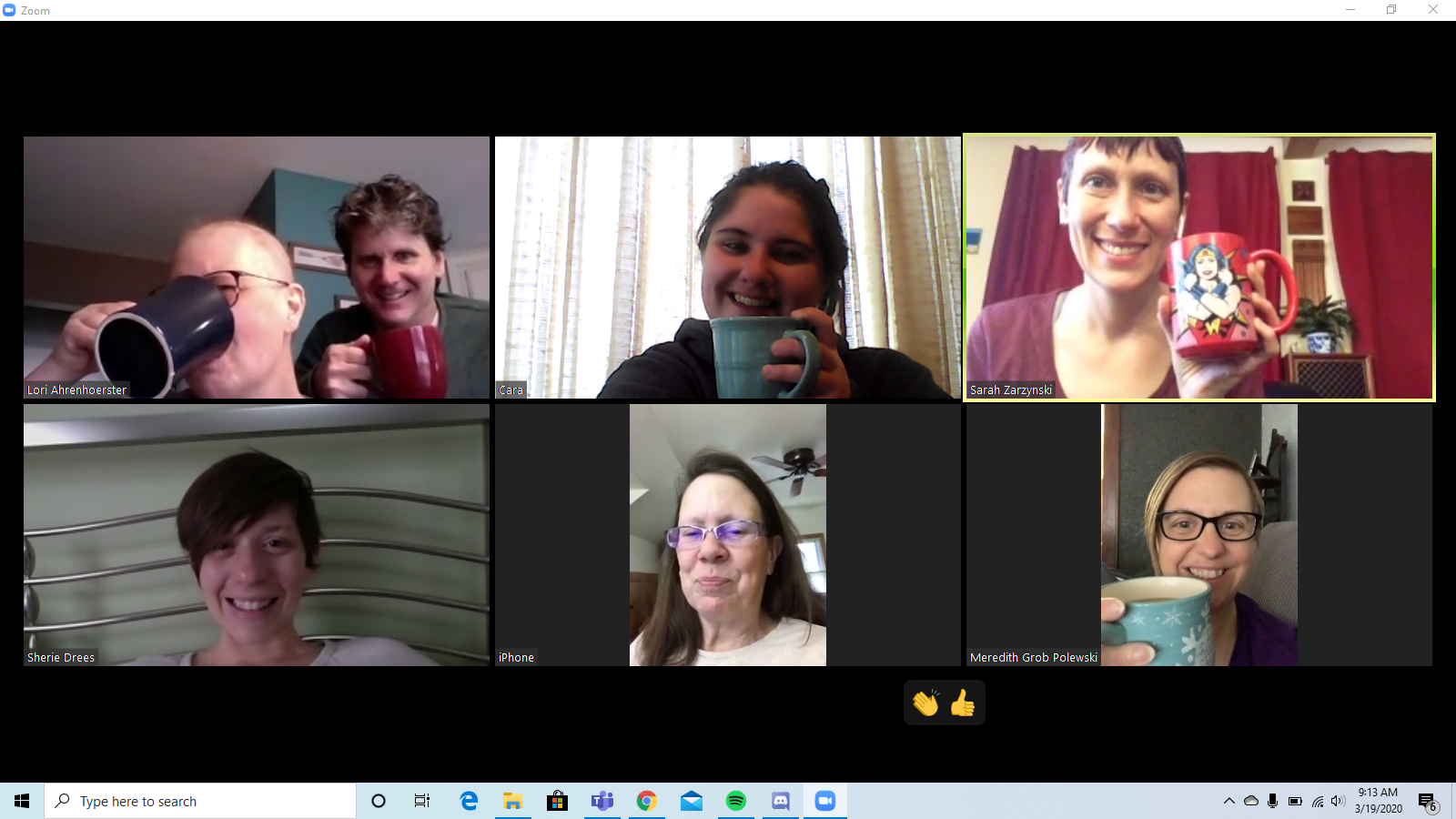
  • I have been introduced to Zoom and I am loving my Zoom coffees!


Stay safe, everyone--and stay home!

Tuesday, March 17, 2020

Eyes on the Prize (more COVID-19)

In the four days since my last post, even more has happened in the world around COVID 19. It's scary, and I find myself (unhappily) thinking more and more about how this potentially impacts me. I don't like having ME be my primary focus. It leaves me with an icky feeling that is a combination of heart racing and knotted stomach.

But I go on, day by day, as we all are.

My blood counts continue to decrease, but I've avoided needing blood products so far (we'll see what Thursday brings). I got a little freaked out when Froedtert called me today to see if I could go to a "local clinic" for my Thursday lab draw instead of the main clinic to minimize exposure to people. Unfortunately, the satellite clinics can't draw from PICC lines and I need my dressing changed, so I have to go to the main site. They told me to wait for results in my car instead of the waiting room. Eek. Scary times.

There is intense need for blood donation all over the world as blood drives have been canceled and people are not showing up for appointments. Apparently a LOT of blood donations are made at High School and college locations--all of which have closed. Please, if you are able, donate blood! Read online about why it's safe, even now. If you're in the midwest, please consider Versiti--all blood donated there stays local. If you donate at the Milwaukee branch, I might even be the recipient of your donation--especially if it's platelets!  Go online and do the pre-registration to minimize the time you wait. 


I was able to speak with the transplant coordinator and learn more about what my next 6 weeks will (hopefully) look like. And I learned more about why my transplant date was moved back a week (so far).

The primary donor they'd initially identified was international. With all the travel restrictions, there was sufficient concern that it might not work out to have cells from an international donor, so they switched to my back-up donor, who is domestic. In addition, normally the recipient (me) would receive a week of intense chemo to prepare for the transplant, and the donor's cells would arrive "fresh." But (again) with the concerns about travel restrictions and all sorts of uncertainties, the plan is now to harvest the donor cells before I start intensive chemo so that they will be cryogenically preserved on site until I am ready for them. Unfortunately this adds another layer of issues, as many people react to the cryogenic preservative. Ugh.

So if all goes as planned (oh, send those vibes!), I have a calendar full of fun stuff.

March 25: Bone marrow biopsy
March 26-April 1: Vidaza (chemo) daily
April 2: Doctor appointment and platelet infusion to prepare for dental work
April 3: Lots of dental work
April 7: Social work evaluation, transplant education, pulmonary function test, EKG and Echocardiogram, and chest and sinus CT Scans
April 13: Labs, psychologist evaluation, transplant doctor appointment, transplant pharmacy consult
April 23 (Day -6): Labs, PICC replacement, admission to BMT unit in hospital, begin chemo (Fludarabine)
April 24-27 (Days -5 to -2): Double chemo (Fludarabine and Busulfan) daily
April 28 (Day -1): Start anti-rejection med (Tacrolimus)
April 29 (Day 0): Receive transplant!!!
April 30, May 2, May 5 & May 10: Anti-rejection med (Methotrexate)
Week of May 17: possible discharge

Whew! LOTS of stuff. And I need to just keep focusing on the end game. I have to keep myself isolated and healthy to be able to make it to transplant, and to be the strongest I can be for transplant. Despite my fears, I have to keep moving forward. Hopefully it'll all work out.


Friday, March 13, 2020

What does COVID-19 mean for me?

Yesterday was Day 15 and an appointment with Dr. Atallah.

My labs are holding ok:
White blood cells: 2.3 (from 2.4 on Monday)
Absolute neutrophils: 1.3 (same as Monday)
Hemoglobin: 10.4 (down from 10.7)
Platelets: 25K (down from 33K, and because they're so close to 20K, I need to go in for labs tomorrow)

------
I have started and re-started a post on SARS-CoV-2/COVID-19 so many times, but before I could post, information and recommendations and seemingly everything that's known has changed!

I won't re-write everything that someone else has already written, although I'll share a few general thoughts (current as of today) and a few great (IMO) links for further reading.

Why is this such a big deal when the flu, suicide, TB, gun violence, etc. all kill more people annually?


Now on to how the COVID-19 pandemic may impact me personally (since this is, after all, my blog about cancer):

I started off, in January, convinced that "the novel coronavirus" was like many other coronaviruses and that influenza was still a much bigger concern. That's definitely not the case now. In the last week or so, I've spent a lot of time thinking (selfishly) how it might impact me, and more specifically my transplant.


  1. I have a weakened immune system. Catching COVID-19 could well prove fatal. I am more likely to catch it if it keeps spreading because people selfishly think it's not a big deal and continue to go out in large groups in public and spread it.
  2. My donor is international. What if travel is not allowed between the country they live in and the US? Would I even be able to get the stem cells?
  3. My donor is young--early 20's. What if they (or their parents) decide that, in these uncertain times, it is too risky to donate stem cells?
  4. There will likely be a surge of patients requiring hospitalization. What if hospitals are overrun with COVID-19 patients and there isn't even a room available for me for the transplant?
  5. Medical providers will likely be stretched by patient care, their own possible illness, being needed to take care of children who are no longer in school or daycare. What if my medical team cannot care for me while I'm in the hospital?
  6. The US gets medical supplies from many other countries, and already many things are becoming scarce. What if I'm in the hospital, but supplies are no longer available, including PPE (important when working with someone immunocompromised) or IV fluids?
  7. I was told that the sooner I get to transplant (after achieving remission), the better. What if my treatment gets pushed back due to all the other priorities, and in that time I fall out of remission and am no longer eligible for a transplant?

At my doctor appointment yesterday I was reassured of some of my fears, but unfortunately not all of them.

I do have to be extra careful to not get sick. But more importantly, my donor is in Europe. I learned yesterday that my transplant has been pushed back by a week. I hope this is the only delay. Unfortunately, pushing it back means that I will require another round of Vidaza. I am trying really hard not to feel sorry for myself.

Round four of Vidaza will be March 26-April 1 (I'll add entries to the google driving spreadsheet when I have exact times).
I'll have a bone marrow biopsy sometime in April.
If nothing else changes, I will be admitted to the hospital for pre-transplant chemo on April 23.
My transplant day will be April 29.

I did learn that they will not start the pre-transplant chemo until they have the stem cells "in the refrigerator" at the hospital, so that at least means that I won't end up with no bone marrow and none coming! I just hope that this schedule is not put off any further. And I need my body to be awesome about keeping me in remission. I am hopeful.

I've been trying really hard to find a silver lining in this delay. I did find one. Last year I signed up for a really cool project, 30 Days of Biking. Essentially you commit to bike every day in April--indoors, outdoors; long, short; fast, slow. I didn't think I'd be able to participate this year, but I'm going to try to ride either 22 Days of Biking or 23 Days of Biking (depending on admission time). I invite any of you to join me in this project--and I will ask for volunteers to ride the remaining days in April FOR me. Kind of like surrogate bikers. Or maybe Handmaid bikers! Will you be a Handmaid biker for me?
If you want to sign up to bike all 30 days yourself, go to: https://30daysofbiking.com

OK, one last thing. I just want to say that since I went to grad school and earned a PhD in Public Health by researching hematopoietic stem cells, I will be SO UNBELIEVABLY PISSED if a pandemic kills me while I'm weakened by my own defective hematopoietic stem cells. I am not a fan of irony. It's time for Buffy the Vampire Slayer to attack COVID-19.

Monday, March 9, 2020

Why you should get vaccinated--for those who cannot.

One more round of chemo down. That's my fourth of any chemos for AML and my third of Vidaza.

I haven't (yet) needed transfusions, as my counts, though I'm technically in nadir, have held okay:

White blood cells: 1.8 Thursday, 2.4 today
Absolute neutrophils: 0.97, 1.3 (able to grocery shop again)
Hemoglobin: 11.4 (wow-that's "normal"), 10.7
Platelets: 50K, 33K (trending downward)

It's interesting that some of the counts are going up, while others down during this period of nadir.

I saw the dentist to prepare for transplant and (unfortunately) I have two cavities that need to be repaired beforehand. I guess you're very limited in dental work (unless an emergency) for a year after a transplant, due to the increased chance of infection. Here's hoping my counts go up before my appointment on April 3rd!

I have started reading more about life after transplant, as it will probably happen in 5-7 weeks from now. The exact timing depends on the donor's availability as well as room in the transplant unit at Froedtert. I'm also trying not to be freaked out by much of it. There's lots on Graft vs. Host Disease (GVHD), which is pretty inevitable--and can range from mild to fatal. If you don't want to read the whole link, here's some highlights:

  • The donated stem cells also include T-cells from the donor. T-cells are a type of white blood cell that target things that can make you sick. 
  • Getting T-cells from a donor provide a benefit in that the donor's T-cells should recognize any remaining cancer cells as foreign, and target them.
  • But a donor's T-cells may also target the host's "normal" cells, which can cause issues ranging from a skin rash to GI upset, vision problems, and even death.
Acute GVHD occurs within the first 100 days after transplant, so this is a particularly vulnerable period. I will be monitored very closely during that time. (Depending on when the transplant actually occurs, that will be until sometime in August, I believe... Missing pretty much all the summer, since among other things, I can't be in the sun while on the anti-GVHD meds.) I will likely need numerous transfusions. I'll be bugging everyone to donate blood, and my colleagues at the North Shore Health Department set up a blood drive for Friday, June 5 from 10-3 in Brown Deer. To sign up as a donor please contact Kala at khardy@nshealthdept.org or 414-371-2985.

I asked about things I can do to prepare for the hospitalization and coming home after. I ordered prescription sunglasses and think I might get a few pairs of sun sleeves, so I can still wear short sleeves and shorts when I get home, but can cover my exposed skin when I go outside. I also learned that when you're in the hospital, they want to minimize disconnecting the IV, so you either have to wear hospital gowns or have shirts that come undone at the sleeve. The nurse mentioned that you can order shirts like that on Etsy, but I think I can make some of my own, using snap tape and the millions of t-shirts that I never wear (of course we just brought a bunch to Goodwill yesterday). Something else to work on while I'm stuck home.

Perhaps the scariest thing that I learned is about vaccines. Because my immune system will be completely knocked out by the transplant, I will essentially be like a newborn baby in terms of immunity--but without the passive immunity provided by breastmilk! I will need to get all my immunizations over again--and I cannot even begin to get until SIX MONTHS after the transplant. Perhaps the most frightening is that I can't receive the two live virus vaccines (MMR & Varicella) for TWO YEARS after transplant. I can only rely on herd immunity--and with recent outbreaks of measles as near as the Twin Cities, that really scares me. 


I could go on and on about the importance of vaccination (I am a public health professional, after all),  and I will say that I was once a delayed vaccinator (before I went to grad school in immunology). However, once I learned about the very real threat to those who could not be vaccinated, weighed against the minuscule risk of vaccines, I realized that it was unfair to put others at risk. 

Additionally, one of the most interesting, compelling, and recent discoveries is that the MMR vaccine is more beneficial to the immune system than getting measles. This is because measles infection actually erases immunological memory, making a person more vulnerable to diseases they'd previously been immune to.  

And so I will be asking friends to stay away if they and/or their children are not vaccinated. If I make it through all this chemo and a transplant, I'm not going to risk my life to a vaccine preventable disease. That risk is just too great.